Lal Krishna Advani's Biograpy & Life Timeline In Pictures | Important Events in Lal Krishna Advani's Life | Quiznest.in
Lal Krishna Advani's Biograpy & Life Timeline
Important Events in Lal Krishna Advani's Life | Quiznest.in
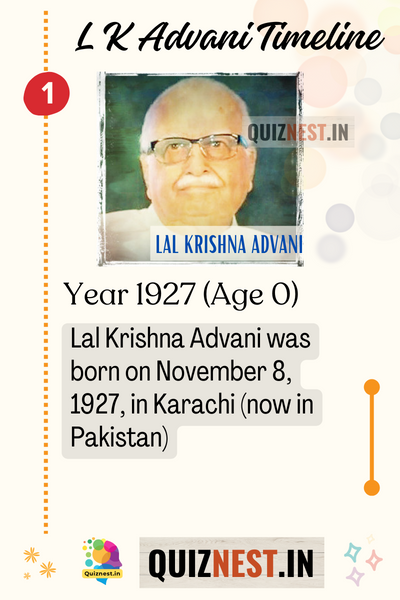
- Lal Krishna Advani, a towering figure in Indian politics, has left an indelible mark on the nation's political landscape. Born on November 8, 1927, in Karachi (now in Pakistan), Advani's journey is characterized by his steadfast leadership, political acumen, and significant contributions to the growth of the Bharatiya Janata Party (BJP) and the broader Hindutva movement.

- Lal Krishna Advani's parents were Late Kishnchand D Advani and Gyani Devi. Born into a Hindu Sindhi family, Advani's early years were marked by the tumultuous period of pre-Partition India.

- He joined the Rashtriya Swayamsevak Sangh (RSS), a right-wing Hindu nationalist organization, in the early 1940s, marking the beginning of his association with the larger Sangh Parivar.
- The partition of India in 1947 led Advani's family to migrate to India. This period profoundly influenced his political ideology.

- Advani played a crucial role in the formation of the Janata Party, a coalition of anti-Emergency forces, which came to power in 1977.

- He served as the Information and Broadcasting Minister during the Janata Party government led by Prime Minister Morarji Desai.
- The Bharatiya Janata Party (BJP) was formally established in 1980, with Advani serving as its president. He played a pivotal role in shaping the BJP's identity as a political force championing Hindutva, nationalism, and economic development.

- In 1990, Advani embarked on the historic Rath Yatra, a pilgrimage to Ayodhya, advocating for the construction of a Ram temple at the disputed site. The movement gained momentum and ultimately led to the demolition of the Babri Masjid in Ayodhya in 1992, a watershed moment in Indian politics.
- Advani was a key player in the decision-making process leading to the Pokhran-II nuclear tests in 1998. The tests marked India's declaration as a nuclear weapons state and demonstrated its capabilities on the global stage.
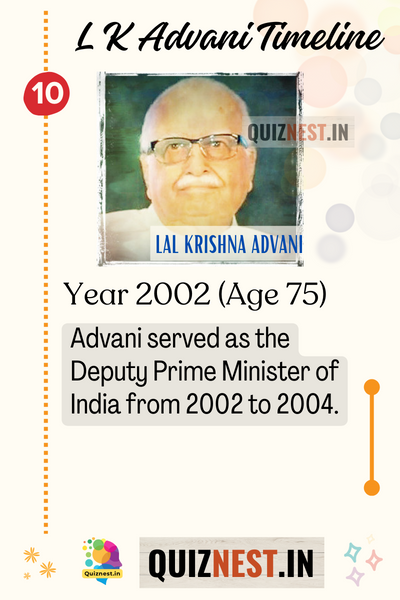
- Advani served as the Deputy Prime Minister of India from 2002 to 2004, under Prime Minister Atal Bihari Vajpayee. He concurrently held the position of the Minister of Home Affairs, focusing on issues of internal security and border management.

- In 2007, Advani was chosen as the BJP's candidate for the presidency, seeking to become the country's head of state. His candidature, however, faced internal opposition, and he withdrew from the race.

- In 2015, Lal Krishna Advani was awarded the Padma Vibhushan, India's second-highest civilian honor, in recognition of his significant contributions to public life. His legacy is intertwined with the growth of the BJP and the ideological evolution of the Hindutva movement in India.

- In 2024, Lal Krishna Advani was awarded the Bharat Ratna, India's highest civilian honor, in recognition of his significant contributions to public life.
Lal Krishna Advani's Noteworthy Quotes:
- "I am a product of the RSS. I am one of those who were part of the RSS and BJP from the beginning." - Lal Krishna Advani
- "The BJP is committed to the development of all sections of the society without any discrimination." - Lal Krishna Advani
Lal Krishna Advani's Legacy and Impact: Despite Advani's withdrawal from active politics, he remains a respected figure within the BJP and Indian politics. His political journey spans over seven decades, marking an era of significant transformation in the political fabric of India. Lal Krishna Advani's life is a tapestry woven with political sagacity, dedication to ideology, and a deep sense of nationalism. As a key architect of the BJP's rise and a central figure in India's political narrative, Advani's influence continues to be felt, shaping the contours of the nation's evolving socio-political landscape.
Recent Quiz Additions

Know the Fascinating
Cultures with This Quiz!

Take World Monuments
Quiz Challenge!